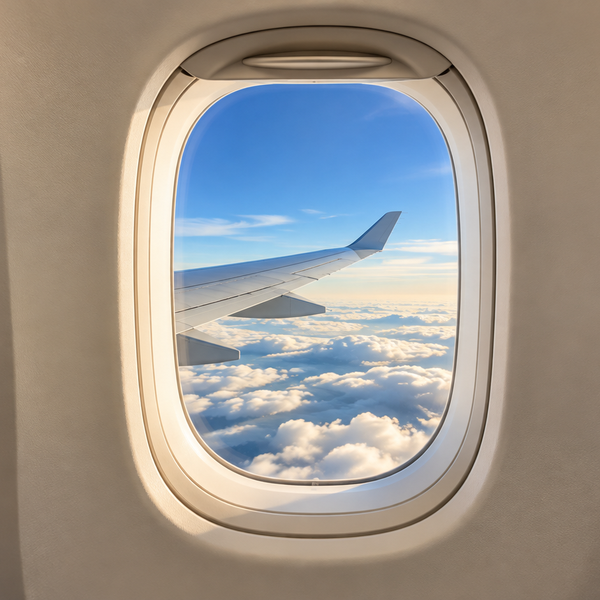



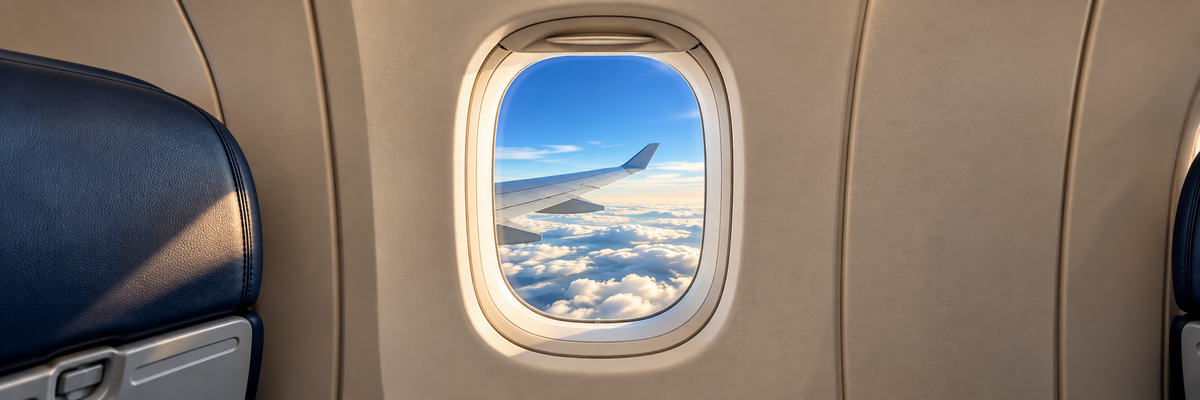
A window seat has a quiet charm. The aircraft lifts, the runway fades, the city becomes smaller, and the journey begins to feel real. Most travellers look through the window for the view, not at the shape of the window itself.
Yet that small curved frame beside the seat carries one of aviation’s most important design lessons.
Airplane windows are not sharp-cornered by accident. Their rounded shape comes from a serious chapter in the early years of jet travel, when aircraft were becoming faster, higher-flying, and more ambitious. To understand why this small curve matters, we need to begin with an aircraft that once made the future of flying feel closer than ever.
The Accidents That Raised a Serious Question
In the early 1950s, commercial aviation was stepping into a new age. The de Havilland Comet became a symbol of that progress, with its first commercial jet service beginning on 2 May 1952. It carried the promise of a faster, smoother, and more advanced passenger journey at a time when jet travel was still new.
Then, in 1954, that promise was shaken.
On 10 January 1954, BOAC Flight 781 departed Rome for London. While climbing through 27,000 feet, the aircraft broke up in flight and crashed into the Mediterranean Sea near Elba, killing all 35 passengers and crew. Less than three months later, on 8 April 1954, South African Airways Flight 201 broke up in flight near Naples while climbing to 35,000 feet, killing all 21 passengers and crew. After the second accident, the Comet fleet was grounded indefinitely.
At that point, aviation had to look deeper. This was no longer about one unexplained accident. A pioneering aircraft, built for a new era of travel, had suffered repeated in-flight breakups. The question was simple, but serious: what was happening inside the aircraft structure that could not be seen from the outside?
The Investigation and What Was Found
To find the answer, investigators had to recreate the repeated demands of flight on the aircraft body. A Comet fuselage was placed inside a water tank and repeatedly pressurized to simulate many flights. Water made the test safer because it is much less compressible than air, so a failure during testing would be less violent than a failure under compressed air.
This test mattered because the Comet was operating in high-altitude flight, where the outside air is much thinner and the cabin must be pressurized for passengers. That pressure difference places repeated load on the fuselage as the aircraft climbs, cruises, and descends. Current pressurized cabin rules require occupied cabins and compartments to provide a cabin pressure altitude of not more than 8,000 feet under normal operating conditions, showing how important pressure control is in passenger aircraft design.
During the water tank testing, the fuselage eventually failed at the corner of a squarish forward escape hatch window. That result became a turning point because it directed the investigation toward fatigue, which is the weakening of material after repeated stress. The Elba wreckage then gave investigators the clearer connection: a recovered section containing the aircraft’s Automatic Direction Finder windows showed signs of fatigue and was identified as the first fracture area in the breakup.
This was the real discovery. The issue was not simply that “square passenger windows caused the accident.” The investigation showed that squarish openings and window frames created high stress concentrations that had not been detected during earlier testing. Because the aircraft structure was repeatedly pressurized in service, those concentrated stress points could fatigue the surrounding material over time.
In simple terms, the window shape mattered because it affected how stress moved through the aircraft body. Abrupt corners allowed stress to gather in specific areas, and repeated pressure cycles could turn that stress into fatigue cracks.
How Modern Airplane Windows Solve This Issue
Modern airplane windows solve this issue by avoiding abrupt corners. Instead of using a squarish shape, aircraft windows are designed with rounded edges so pressure-related stress can move more smoothly around the frame.
The solution is simple to see, but serious in purpose. A rounded edge does not force stress into one sharp point. It gives stress a smoother path around the window opening. That is why modern aircraft windows are usually oval or softly rectangular. They do not need to be perfect circles. The important point is that the corners are rounded, not sharp.
This is also why saying airplane windows have “no corners” is not fully accurate. Most aircraft windows still have a clear shape, but they do not have sharp corners. The safety detail is in the softened edge, because curved edges help reduce stress buildup around the opening.
That lesson continues beyond the window itself. Modern aircraft design gives serious attention to fatigue testing, material behaviour, structural geometry, production standards, maintenance, and real operating conditions. The curved window is one visible result of a wider safety principle: every aircraft part must be designed to remain reliable across years of service.
So, the next time you look out of an airplane window, the view may still be what catches your eye first. But the curve around that view carries its own story. It is a small design detail shaped by a serious aviation lesson, and a quiet reminder that safer flying is built through learning, testing, and careful attention to details passengers may not always notice.
Source note: This article is based on aviation safety records and technical lessons from the FAA’s Lessons Learned case study on the de Havilland Comet, supported by official pressurized cabin requirements from the Electronic Code of Federal Regulations.